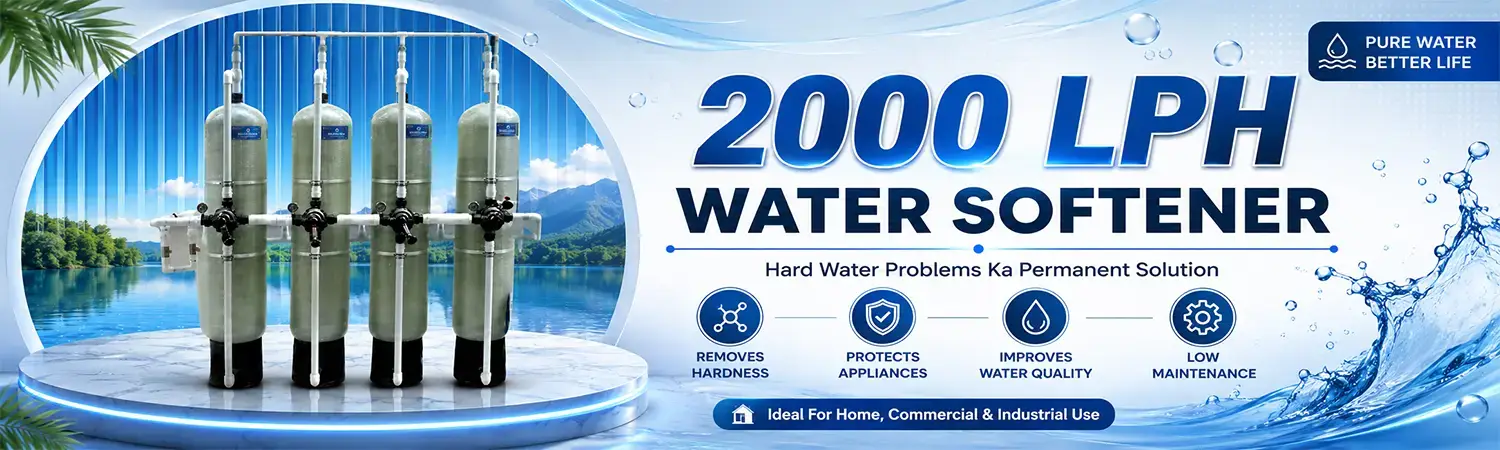
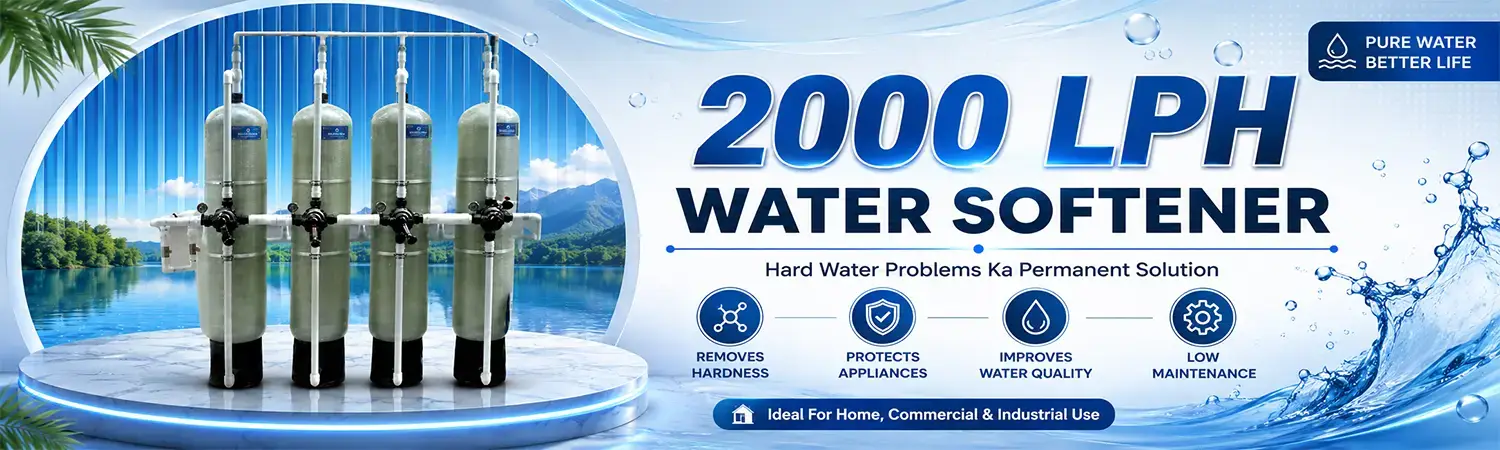
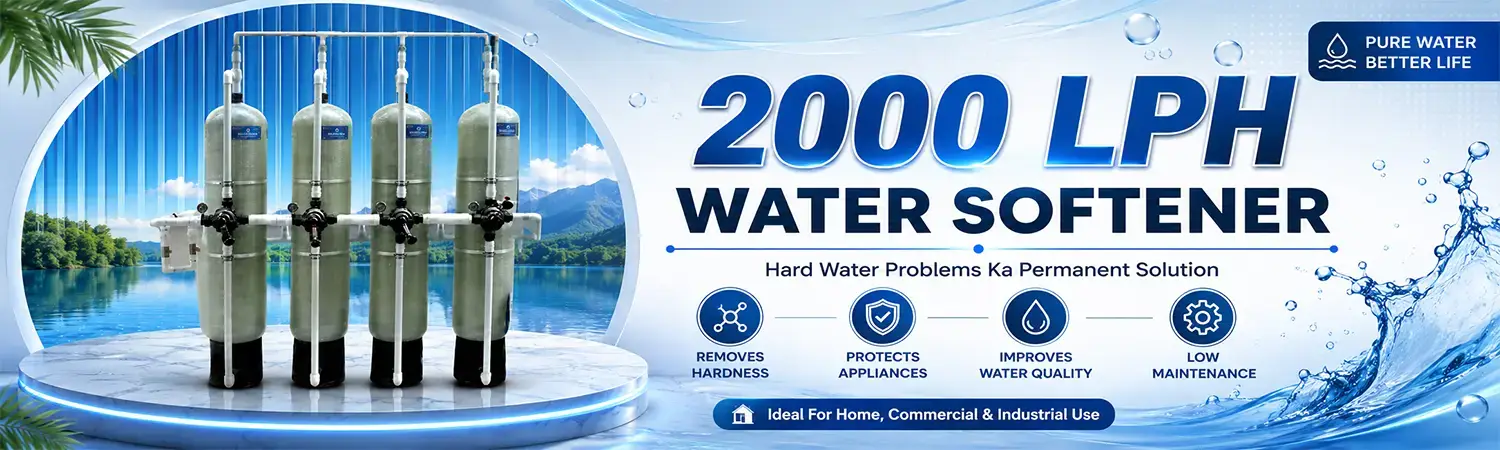
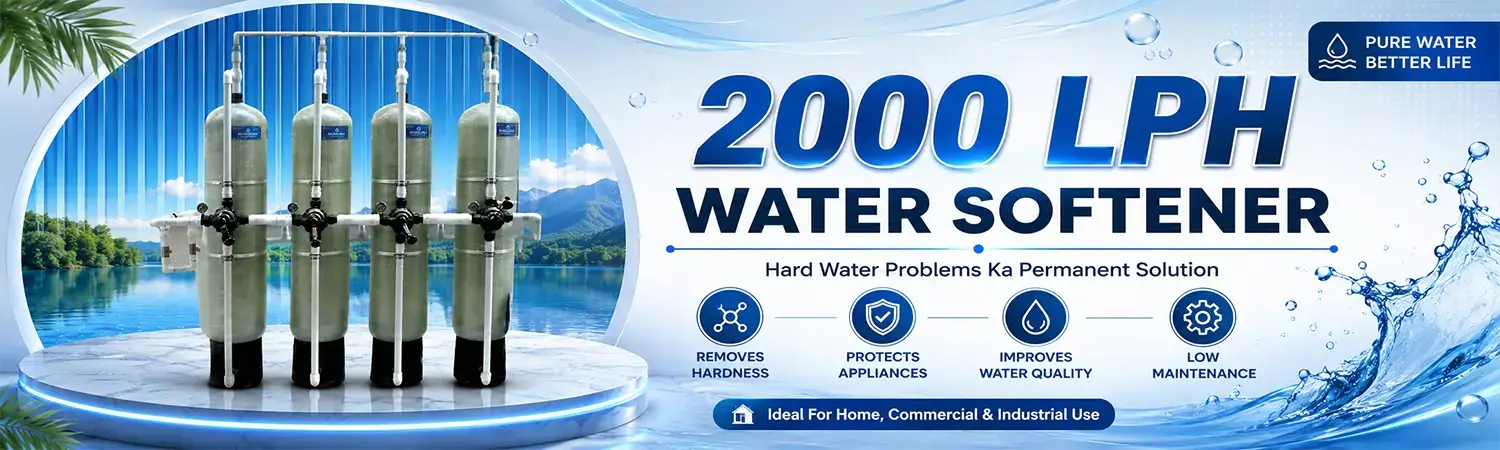
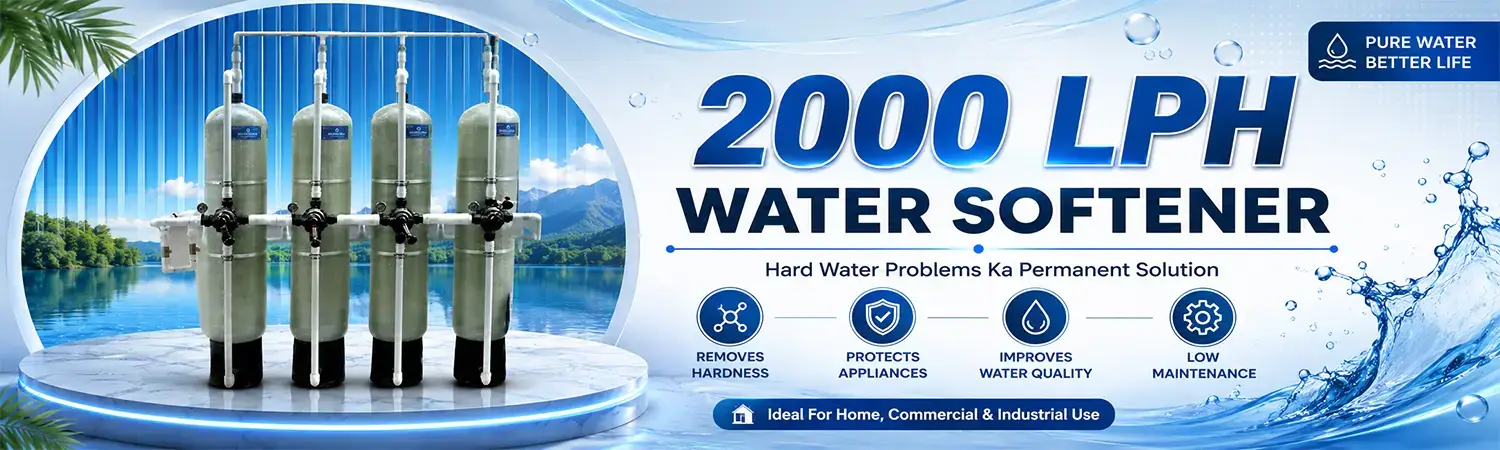
2000 LPH RO WS in Delhi

2000 LPH Water Softener : Reliable Solution for Industrial & Commercial Applications
In industrial and commercial setups , hard water often leads to scaling , equipment damage , and higher maintenance costs. A 2000 LPH ( Liters Per Hour ) Water Softener is designed to tackle these problems by delivering a steady supply of soft water. This system helps businesses enhance productivity , extend equipment lifespan , and cut operational downtime.
Why Choose a 2000 LPH Water Softener ?
Hard water contains calcium and magnesium salts that cause scaling in boilers , pipelines , cooling towers , and RO plants. A 2000 LPH softener removes these minerals to keep operations smooth. It prevents scaling and corrosion , improves the efficiency of detergents and chemicals , reduces frequent maintenance , and ensures high quality water for industrial and commercial use. Ultimately , it helps lower costs and boosts overall efficiency.
Key Operational Benefits
-
Maximum Scale Protection: Prevents scale encrustation in boilers, cooling towers, commercial heaters, and high-capacity RO systems.
-
Significant Chemical Savings: Decreases soap, detergent, and processing chemical consumption by up to 30–40% across commercial washing and cleaning operations.
-
Lower Energy & Maintenance Costs: Keeps heat exchangers operating at peak thermal conductivity, reducing fuel and electricity bills.
-
Reliable Continuous Flow: Delivers up to 2,000 liters of treated soft water every hour to meet demanding peak operational requirements.
Key Technical Features
-
Premium Cation Exchange Resin: High-capacity strong acid cation (SAC) resin ensures rapid ion-exchange and optimal hardness reduction per cycle.
-
Heavy-Duty FRP Vessel: Enclosed in a corrosion-resistant Fiber Reinforced Plastic (FRP) vessel built to withstand continuous hydraulic pressure and harsh mineral loads.
-
Versatile Control Valve Options: Choose between a heavy-duty manual multiport valve (MPV) for simple operation or a fully automatic digital controller for hands-free regeneration routines.
-
Complete System Package: Comes equipped with a high-capacity brine tank, brine suction valve, internal distribution strainers, and durable interconnecting pipework.
Ideal Applications
-
Large Residential Complexes & Hostels: Centralized soft water distribution for apartment buildings, dormitories, and hotels.
-
Pre-Treatment for 2000 LPH RO Plants: Protects reverse osmosis membranes from scaling, prolonging membrane life and stabilizing permeate quality.
-
Commercial Laundries & Textile Units: Ensures brighter fabrics, softer linens, and reduced detergent usage.
-
Food, Beverage & Pharmaceutical Processing: Guarantees consistent water quality without mineral precipitation or off-flavors.
-
Cooling Towers & Boiler Feedwater: Prevents thermal efficiency loss and tube failures caused by scale deposits.
Why Source 2000 LPH Water Softeners from Romegamart?
At Romegamart, we streamline B2B procurement by bridging industrial buyers directly with trusted manufacturers and primary suppliers.
-
Direct B2B Pricing: Source high-grade softeners and industrial spares at competitive wholesale rates.
-
End-to-End Spares Support: Easily order replacement resin, multiport valves, distributor strainers, and brine components in one place.
-
Rigorous Quality Standards: Engineered for heavy industrial duty cycles and compliant with standard hydraulic safety norms.
-
Reliable Pan-India Delivery: Fast, coordinated shipping to keep your project deadlines on schedule.
Frequently Asked Questions (FAQ)
1. What does a 2000 LPH water softener plant do?
A 2000 LPH (Liters Per Hour) water softener uses an ion-exchange process to remove calcium and magnesium ions—the primary causes of water hardness—and replaces them with soluble sodium ions. This prevents lime scale accumulation in piping, boilers, and commercial appliances.
2. How do I determine if 2000 LPH is the correct capacity for my facility?
A 2000 LPH unit provides up to 2,000 liters (2 $\text{m}^3$) of soft water per hour. It is ideal for multi-story residential buildings, medium-scale laundries, food processing units, or as pre-treatment for a 2000 LPH RO plant. If your peak hourly water consumption exceeds 2,000 liters, consider upgrading to a higher capacity or a dual-vessel twin-alternating configuration for uninterrupted 24/7 flow.
3. What is the difference between manual and automatic control valves?
-
Manual Multiport Valve (MPV): Operates via a simple hand-turned lever to cycle through service, backwash, brine draw, and rinse stages. It is economical and easy to operate manually.
-
Automatic Control Valve: Uses a digital timer or meter to trigger regeneration automatically when the resin becomes saturated. It saves labor and ensures consistent water quality without manual tracking.
4. What salt should be used in the brine tank for regeneration?
Always use high-purity, clean sodium chloride (salt crystals or solar salt) intended for water softeners. Avoid fine table salt or unrefined salt containing silt, as impurities can clog the brine injector valve and damage the resin bed.
5. How long does the cation resin last before needing replacement?
Under normal operating conditions with regular regeneration and clean feed water, industrial cation resin lasts 3 to 5 years. If feed water contains high levels of chlorine or iron, installing pre-filters (such as activated carbon or iron removal filters) will extend resin service life.
6. Will a 2000 LPH water softener reduce the TDS level of my water?
No. Water softening is an ion-exchange process that replaces hard minerals (calcium/magnesium) with sodium ions, leaving the Total Dissolved Solids (TDS) concentration virtually unchanged. If you need to lower high TDS levels, a Reverse Osmosis (RO) system is required alongside or after the softener.